


Rugby vs American Football: Learn the 12 major differences in rules, scoring, equipment, field size, players, and gameplay. Complete 2026 guide with FAQ.
Rugby Union and American Football have some common roots but both games have evolved into radically different sports in terms of rules, safety equipment, playing styles and ways to score. Below, we break down each differing aspect of these two fascinating sports.
The quick answer: the most obvious difference?
What clearly sets the two aside is their playing style and pass limitations: rugby union offers the possibility of having continuously ongoing gameplay and only backward or lateral passes using hands.
American football has a stop-start gameplay which is centered around sets of plays and one single forward pass allowed at every down. Origin: Common Ground The common root that these two sports have come from is the old version of football games at English schools in the 19th century. American football is a derivation of rugby union brought at American colleges during the 1870s, along with a few additions to the sport such as the use of a forward pass and a line of scrimmage.

The side-by-side chart for Rugby vs American Football:
| Features | Rugby Union | American football (NFL) |
|---|---|---|
| Number of players on field | 15 per team | 11 per team |
| Game duration | 80 minutes (two 40 minute halves) | 60 minutes (four 15 minute quarters) |
| Field dimensions | ~100 m 70 m (larger, no yard lines) | 100 yards 53.3 yards (gridiron style yard lines for each 10 yd line and 10 yd end zones) |
| Forward passing | Permitted; only forward passes allowed allowed one per play and only if thrown from behind the line of scrimmage, not permitted backwards/lateral by hand. | None-only backward or lateral passes by hand. |
| Protection | Minimal (mouth-guard, sometimes soft-headgear) | Bulky ( helmet, pads, overall protection) |
| Major points | Tries, Conversions(5 + 2), Penalties/Drop Goals (3) | Touchdowns (6), field goals (3), extra point (1) |
| Continuous play vs. Discrete plays | Constant continuity vs. | Regular starts and stops |
| Tackling | Player must release the ball, no blocking permitted. | Blocking is legal and is essential to open ways for the ball carrier. |
| Team Substitutions | 8 total (some can be returned) | Unlimited anytime between plays |
| Ball shape | More round, larger circumference than american football. | Elongated ends, with laces. |
| In-goal area | 5.5 - 24 yards at the end of the field. | 10 yards from the end line back to the line of scrimmage. |
| Downs system | No system (continuously flowing play) | 4 downs for 10 yards gain. |
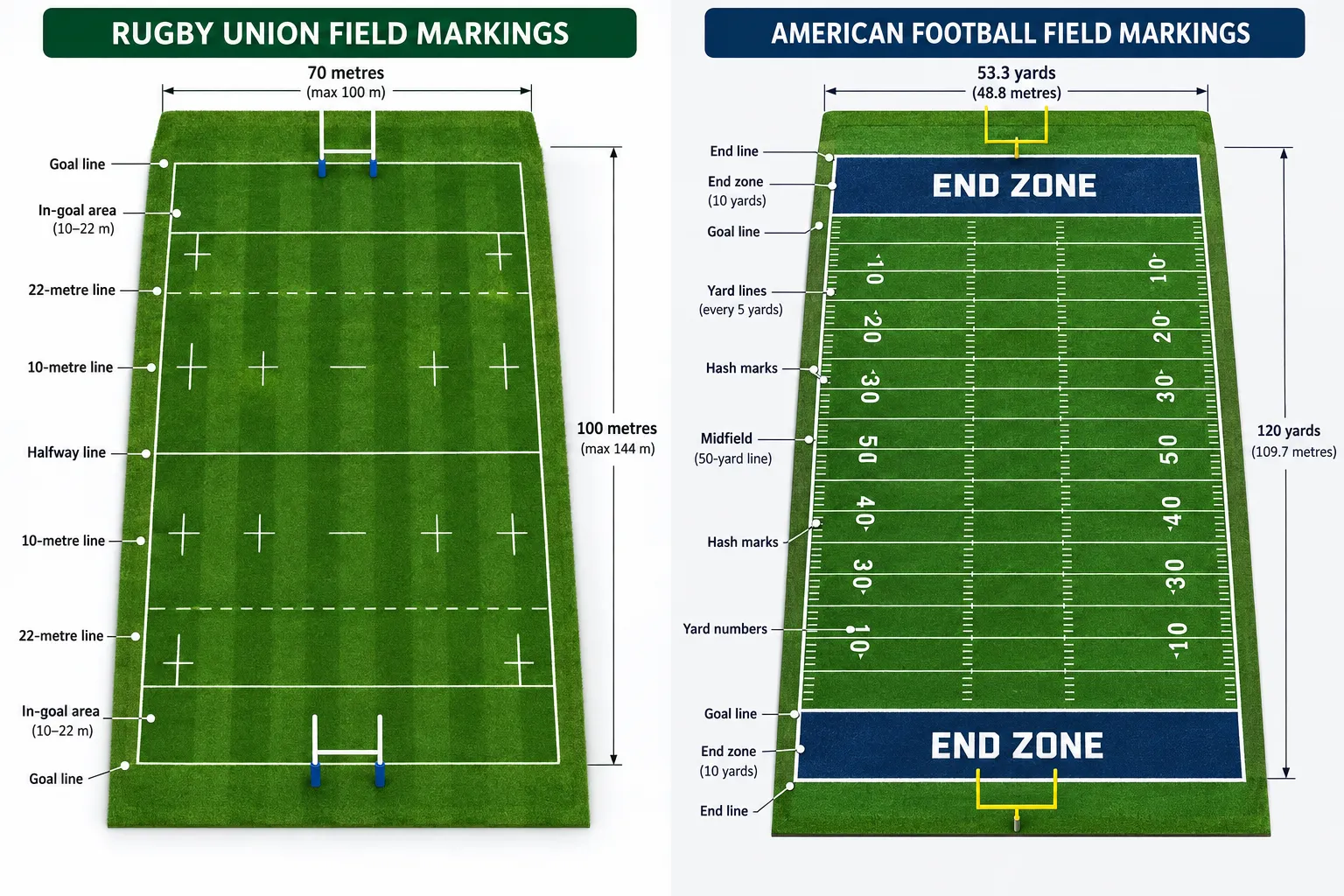
[Image: Rugby Union field compared with an American football field]
Breakdown of every difference:
1) Player Count
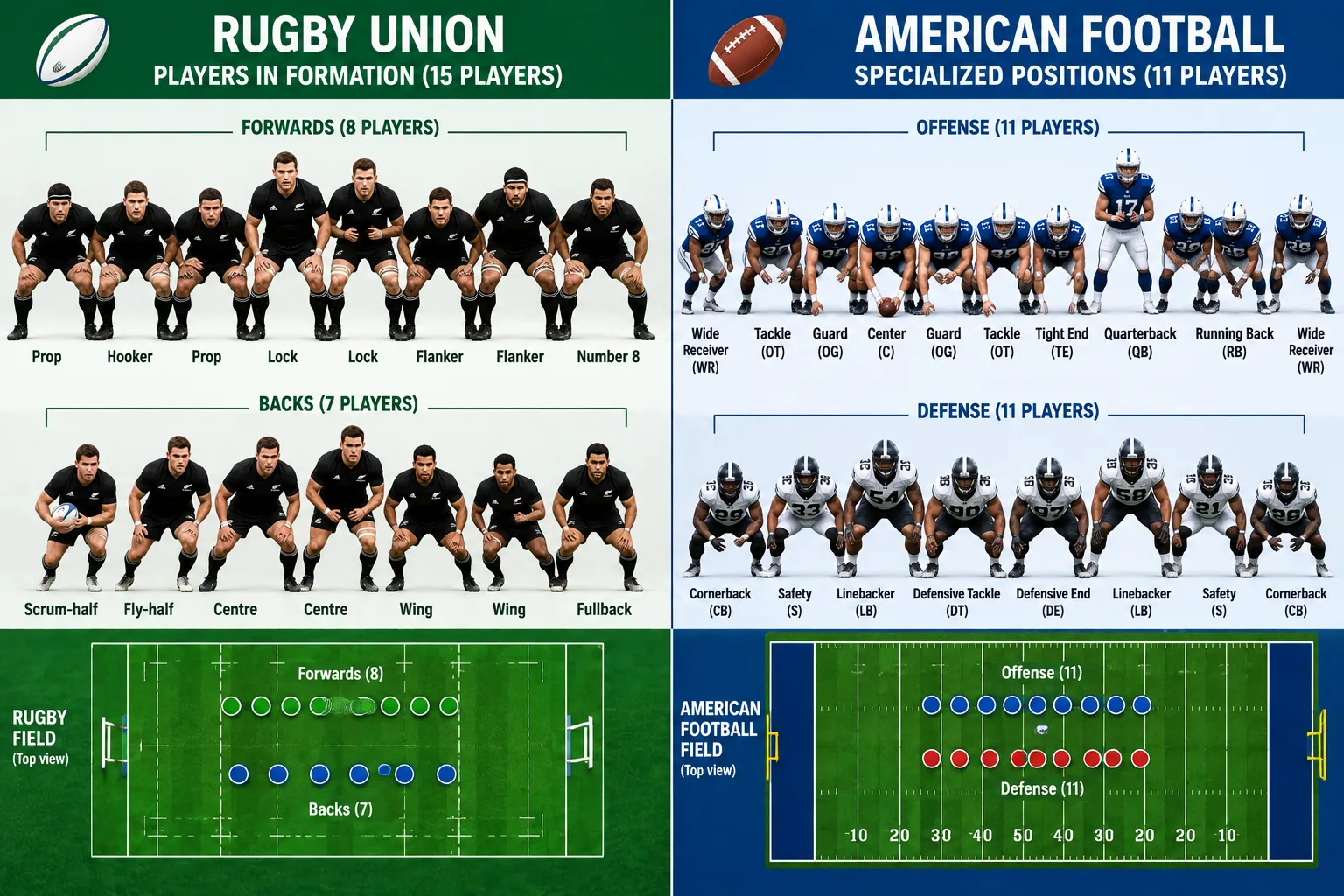
15 players is the rugby team size at every given moment on the field whereas it is 11 players at any given time in the American football game. Rugby relies on endurance and well-roundedness from the players, unlike football, which depends on player specialization and substitutions after every down.
2) Field Measurements and Markings
The dimensions of the american football field are 100 yards long and 53.3 yards wide with yard lines at every ten-yard mark on a gridiron along with two 10 yard end zones to protect the sanctity of a touchdown score.
Rugby fields are longer by 100 meters to 70 meters in wide and have 22 and 10 yard markings with additional in-goal zones from 5.5 to 24 yard length.
3) Game time and Structure
80 minutes total from two 40 minute halves will be the length of a rugby game, with no stoppage in game. It consists of a 10 minute halftime but continues after with little to no pauses. A 60-minute football game consists of four 15 minute quarters.
Unlike rugby, continuous play isn't present since a play, down and yard-play is essential which would make the clock time exceed up to 3 hours.
4) Passing Rules
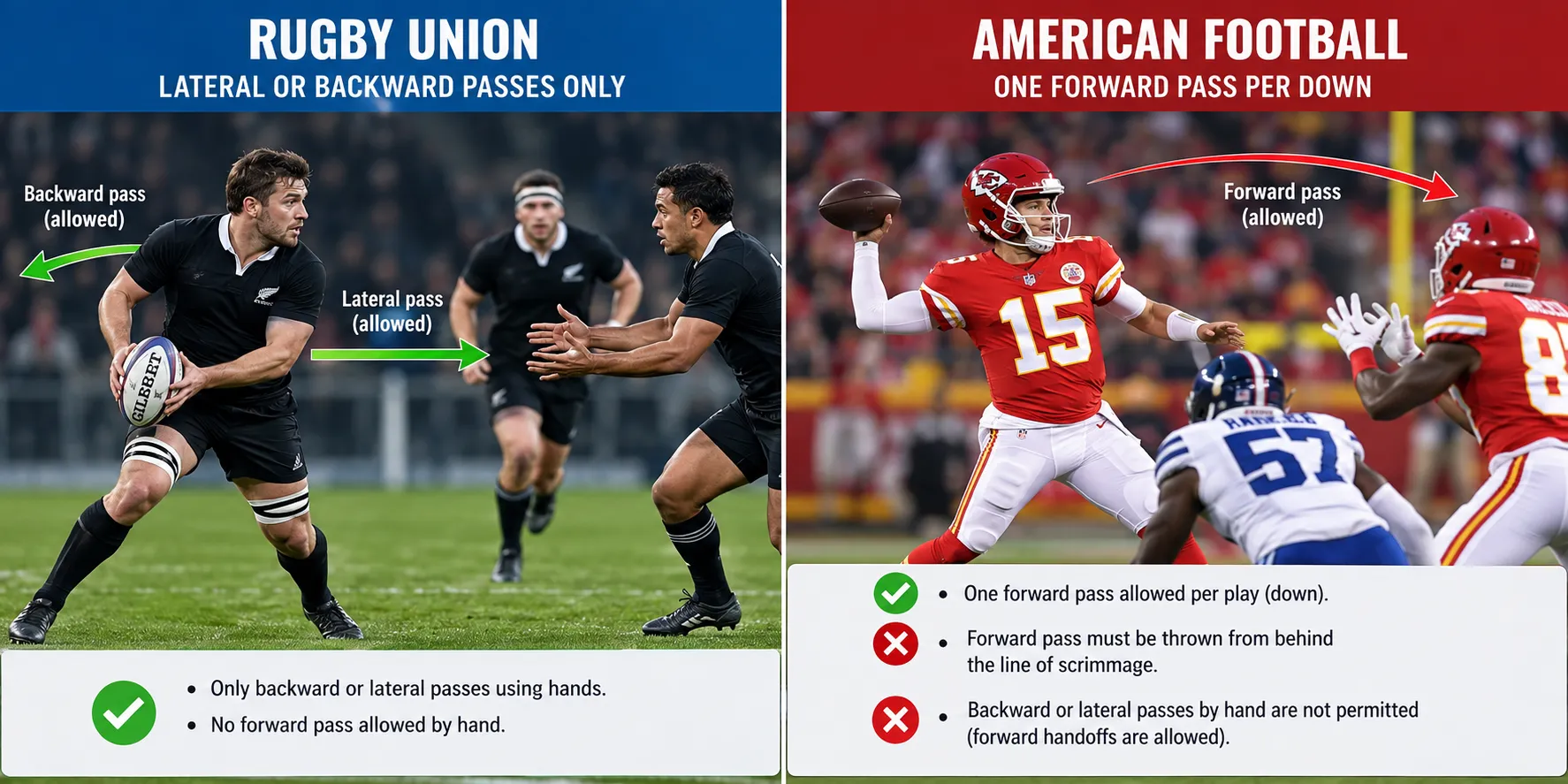
These are some the key rules that define each sport by far. Rugby does not allow for forward passing by hand so passing backward and laterally with your hand is the only options for passing.
The American Football game permits only one forward pass for every down if from behind the line of scrimmage.
5) Protection/Safety Equipment
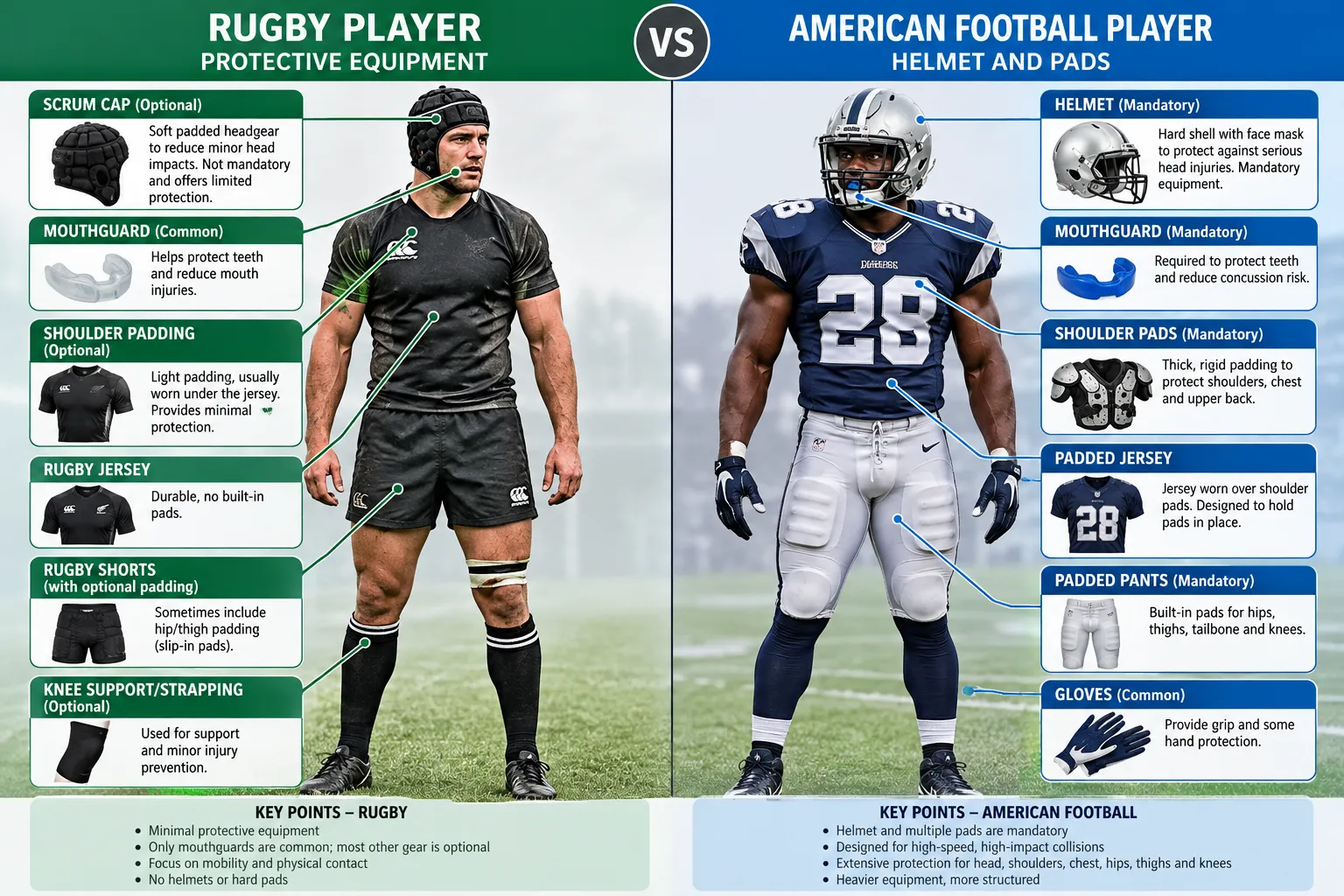
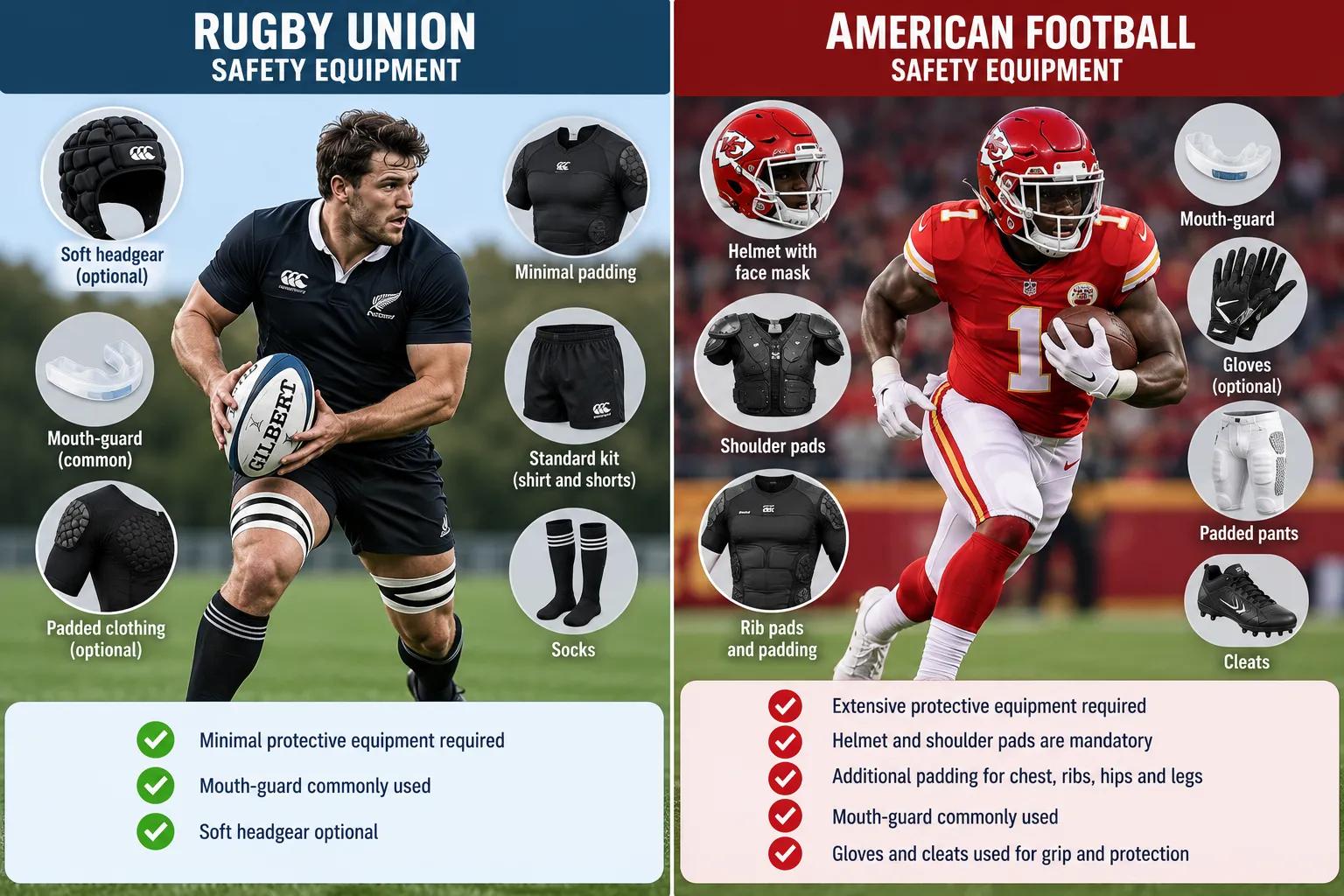
Like stated in the first paragraph and the description of those who play. Rugby minimal protection unlike American Football. Minimal protection is mouth-guards. Max to use for head protection is a soft helmet that does little damage in a collision compared to fully covered helmet on the entire head in American football; padding should extend to the shoulders and beyond.
6) Pointing System
The system by which a team score is achieved differs quite a bit.
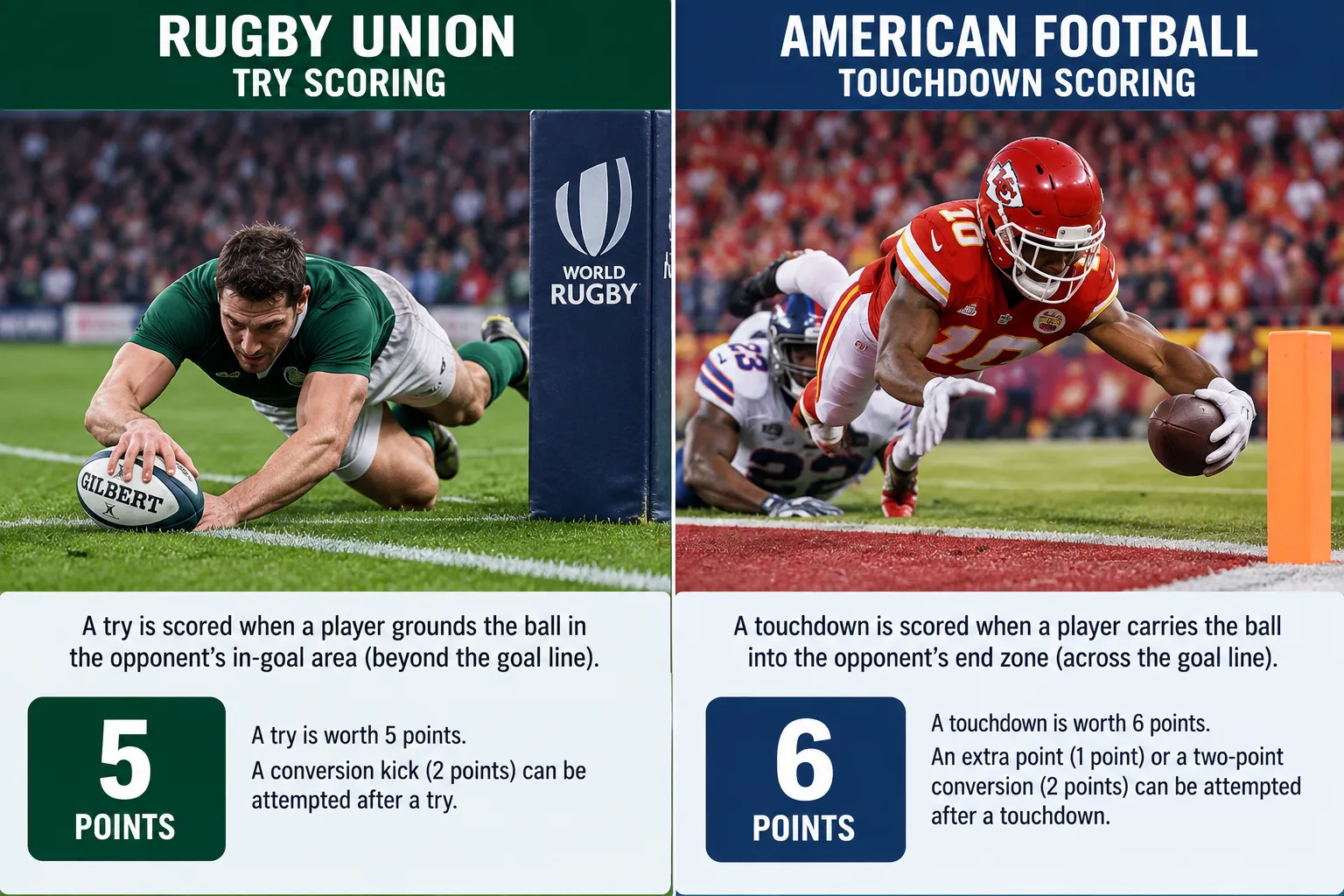
Points from tries in rugby occur from scoring one of the two end zones which will get them 5 points followed by a 2 point conversion with a field goal or penalty goal only getting them 3 points. A touchdown in American football scores six points if any player on the offense crosses the planes of the end zones with the ball. The offense can opt for a 1-point or a 2-point extra point afterward but scoring three points by way of a field goal is also possible.
7) Play Continuity and Downs
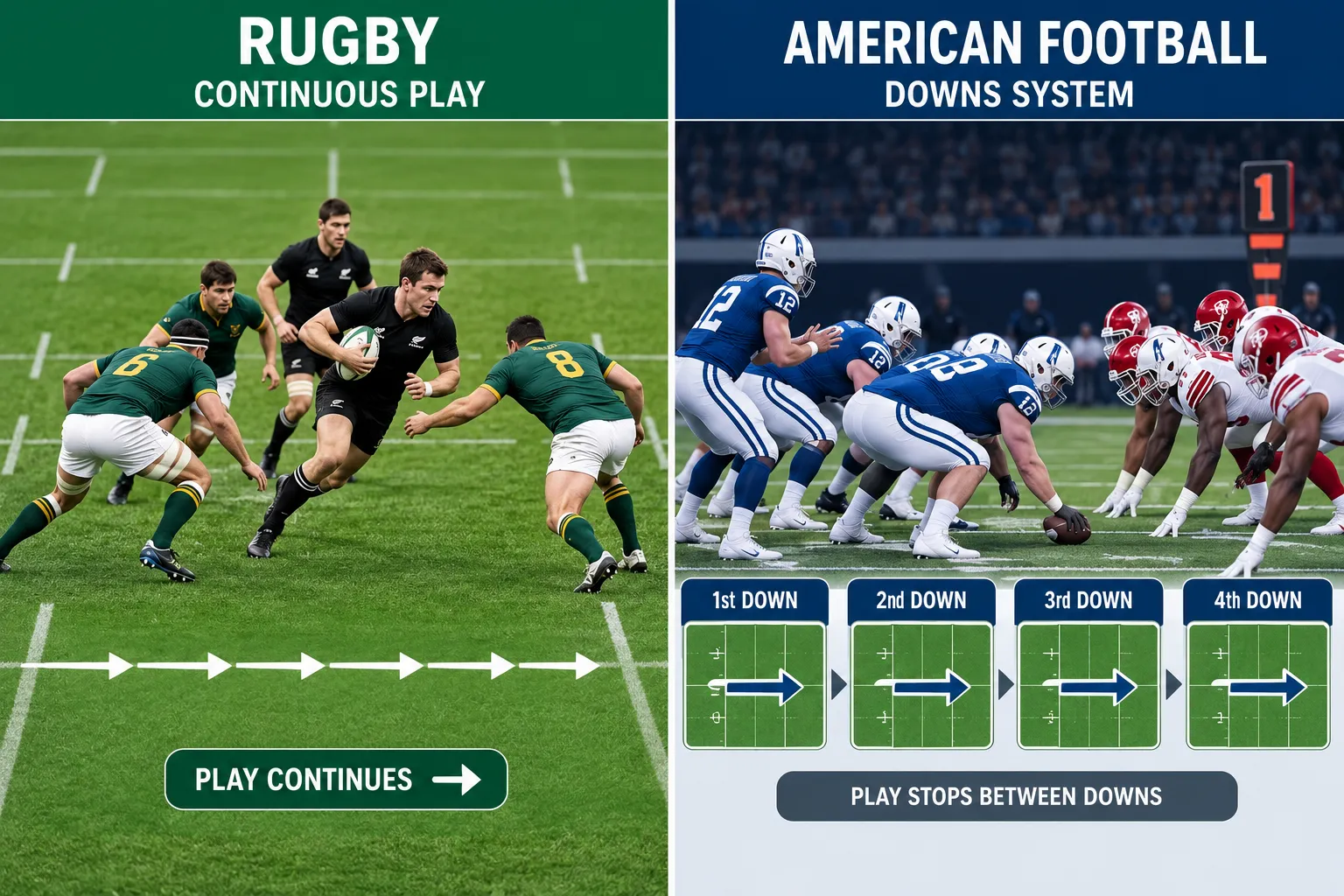
No plays in rugby exist since rugby always has active players on the field where players possession is determined not on four downs like american football but when a penalty is committed or the ball go out of bounds. Rugby can lose possession of their ball at any time; american football loses possession only after being unsuccessful gaining 10 yards and more after four downs are lost.
8) The way you tackle a football player vs a rugby player
This refers to specific rules about tackling.
Blocking in american football serves as a way to create a path for the ball carrier by physically stopping defenders from having the opportunity to reach the carrier.
In rugby though it would not be beneficial, and in fact illegal, to prevent the defender from reaching a given ball carrier. Instead you are to wrap your arms around their waist and take them down from the shoulders using your body to do so.

9) Substitution Differences
Unlike American Football where there is no limit for substitution, the game of Rugby has 8 maximum of subs allowed. What distinguishes them further, is the possible to re-introduce subs, some of whom can return to game in cases of injuries (such as bleeding eyes) to a player.
10) Ball Shape
A football is typically a prolate spheroid which has pointed tips laced with stitches that is much better to hold.
The rounder rugby ball is typically larger in circumference.

11) Tactics and specialization
Rugby games must be physical and involve many players, therefore requiring toughness, agility, and stamina so that each player can be well-rounded. In contrast, football favors specializations: kickers are good for kicking, quarterbacks are good with throwing etc so it relies a lot on the speed and explosive performance on one selected part of your body.
12) Safety risks
In both sports, there's an element of danger present. In rugby, where minimal protective gear is worn, injuries often include things like slices and minor contusions on most of the skin, and general issues regarding lower body and muscle injuries that need up to months of rehabilitation depending on the injury, while on the other hand, rugby has fewer instances of concussions than its counterpart; American football is known for its higher concussion and brain related symptoms and illnesses, which causes long term damaging consequences for the players to endure with the sport's equipment protection and style of play encouraging a higher speed and rate in contact collisions than with Rugby.
Which is moredangerous
Sports have danger for the players in both ways: Rugby games and matches require stamina and resilience on players all throughout the Eighty minutes where the players have minimal protective gear; they must be strong enough to resist blows.
American Football requires explosive strength, and players can endure great collisions with higher force since they are protected.
Rugby may generate more total Injuries but those of American Football are usually more long term.
FAQ: Rugby vs American Football
Can you pass forward in rugby?
No. Forward passes by hand are illegal in rugby; the ball must travel backward or laterally. Teams advance via running or kicking.
How many players are on a rugby team vs football team?
Rugby union has 15 players per side; American football has 11 players per side on the field at a time.
Is rugby more dangerous than American football?
Both are dangerous in different ways. Rugby has more total injuries from unprotected contact; American football has higher concussion rates from helmet-enabled impacts.
Why does American football use helmets and rugby doesn't?
American football's stop-start structure and forward-passing game enable higher-speed, targeted collisions, making helmets necessary. Rugby's continuous play and tackling technique rules prioritize safer contact without heavy padding.
Which sport is older?
Rugby is older, codified in 1845. American football evolved from rugby rules in the 1870s–1880s with U.S. college innovations.
How long is a rugby game vs NFL game?
Rugby: 80 minutes (two 40-minute halves). NFL: 60 minutes (four 15-minute quarters), though actual broadcast time exceeds 3 hours due to stoppages.